
| Common Name | Scientific Name | TESTIMONIAL "Thank you. We seem to be rid of the bed bugs and the roaches also. HH - California |
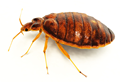
| Bed Bug | Cimex lectularius | |
| Tropical Bed Bug | Cimex hemipterus |
Little Vampires of the Insect World
Bed bugs have invaded homes, even five-star hotels, with a vengeance and at lightning speed. These grisly little nocturnal bugs only come out at night searching for a blood meal. Their residence is our beds and bedrooms. If you are looking for a natural bed bug spray that actually works, you are in the right place.
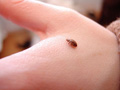
These creepy crawling night stalkers feast and feed by sucking human blood. They pierce the skin with their elongated beak, like a hypodermic needle. Bed bugs inject their victims with their saliva, which contains a numbing agent. They drink until they become engorged with a person’s blood, crawling away satisfied, until the next night.
The common bed bug (Cimex lectularius): They “glue” their eggs in hiding places. The nymphs hatch in about ten days and molt five times, taking a blood meal between each molt. The life cycle from egg to adult varies between 36 and 120 days. This life span depends on conditions, as nymphs can survive long periods of starvation, up to a year!
Tips for Bed Bug Removal in the Home
- They cannot crawl up smooth surfaces. Remove the bed-skirt if you have one. Coat the legs of the bed with a light coating of Vaseline or cooking oil, or place the legs of the bed in glass or plastic containers.
- IRON your mattress, especially the edges!
- After misting your mattress with Kleen Green enzyme bed bug spray, wrap the mattress in plastic. This is one of the most effective bed bug treatments without chemicals available today.
- Wash and/or dry bedding and towels daily if necessary.
- Use a small amount (about 1/2 oz.) of Kleen Green in a steam vac for superior cleaning.
- Persistence in spraying daily may be necessary for several days.
- Use vacuum attachments to clean cracks and crevices. Caulk or seal these openings permanently.
- Inspect dresser drawers and wash and/or dry clothing if necessary.
- Use canned air or a hair dryer on high heat to blow out tight areas such as ornate wood headboards.
- TIP: Plumbing or radiator-type heaters with piping in the floor can serve as an entrance point into your apartment from another apartment. Secure any space around plumbing or heating elements with caulking, aluminum foil, or steel wool.

Why and How Kleen Green™ Works
Insects are made up of a high concentration of protein. When Kleen Green is introduced to the insect, the enzymes act and can cause the insect to molt (shed its outer coating) prematurely. Poison pesticides attack the nervous system of the insect, which is not always effective. University research has noted that some insects have developed a resistance to poison-based products.
This is exactly why Kleen Green stands out as the best spray for bed bugs. Unlike conventional pesticides, Kleen Green’s enzyme action targets the insect’s exoskeleton directly, leaving no toxic residues. Preformed enzymes have been used widely in restaurant and institutional settings for the last ten years, due to their low toxicity and superior cleaning properties. They are also becoming widely accepted in the field of pest control, as enzymes leave no toxic residues and the enzymatic effect on the insect exoskeleton is quick and safe. SAFE for gardens, plants, ponds, and around children and pets!
A Natural Alternative to Toxic Products
- Fast Acting
- Does Not Produce Toxic Fumes
- Extremely Economical
- More Effective and Safer than Pesticides!
When it comes to choosing a safe bed bug spray for mattresses and sleeping areas, Kleen Green is the clear choice. It is hypoallergenic, completely biodegradable, and free from the harsh chemicals found in conventional pesticides. Whether you are treating your bed frame, box spring, or surrounding furniture, this is a true non-toxic bed bug treatment you can use with confidence around your family.
Kleen Green: Non-Toxic, Pesticide Free Spray

Super Concentrated - Pesticide Free
- 8 oz makes 2 quarts
- 16oz makes 4 quarts
- 32oz makes 8 quarts
- 64 oz makes 16 quarts
- 128oz makes 32 quarts
- Also available in 5 gallons
THE MOST SUPERIOR NON-TOXIC REMEDY ON THE MARKET TODAY
| INGREDIENTS: Active ingredients: A specially formulated broad spectrum of NATURAL enzymes (protease, amylase, cellulose, lipase) derived from innocuous yeast strains. FDA good grade ingredients. GRAS (FDA Generally Regarded As Safe) List Parts 184 and 186. This product is not a pesticide. |
How to use Kleen Green™ Enzymes
- This nontoxic product provides superior cleaning in the entire home, eradicating and digesting dirt, bacteria, and microscopic mites - even dust mites.
- Spray and/or mist cracks, crevices, around window and door frames daily for several days. Persistence and patience will give the best results when using Kleen Green. No need to leave your home like that with pesticides. Kleen Green does not produce any toxic fumes. Kleen Green Enzymes eliminates offensive odors.
- Safe to spray on all surfaces: carpet, bedding, walls, floors, and furniture.
- Kleen Green may be used in the laundry and in carpet cleaning machines.
- Pour 1oz. of concentrate directly into the wash load without detergent for a fresh, clean laundry.
- TIP: Kleen Green is safe to use in humidifiers. Pour 2 to 4 oz. into your humidifier for eliminating odors and controlling airborne bacteria, germs, and pests.
How to Use Kleen Green for Treating Bed Bugs:
- Spraying with Kleen Green, the best natural bed bug spray, instantly cleans away bed bugs!
- Apply a light mist to the entire mattress. Pay particular attention to spraying mattress seams, buttons, and tears. Don’t forget to treat the bottom of the mattress, box springs, and bed frame.
- The objective is not the quantity of spray used, but rather the proper placement of the enzyme cleaner.
- Spray Kleen Green into cracks, crevices, and corners! BE THOROUGH.
- Inspect and spray along baseboards, window frames, wallpaper edges, heat registers, and other moldings. As it may be impossible to penetrate all hiding places immediately, control may not be immediate, and bugs may be seen for several days after treatment.
- Vacuum thoroughly. Check behind pictures, drapes, wall sockets, and even closets.
- ATTENTION APARTMENT/CONDO RESIDENTS: Plumbing and heating pipes are like a freeway for a bed bug! Caulk or seal any space around plumbing pipes. Then vacuum and spray Kleen Green liberally all cracks, crevices, and corners.
- On Guard Bug Dust (nontoxic diatomaceous earth) provides a powerful residual. Death is within 24 hours. Apply to any crack, crevice, or corner. Safe on beds
Tips for Travelers
- Examine the hotel/motel room by pulling the bed covers down. If you see moving or crawling pests, or if you see dark spots on the sheets, request to be moved to another room immediately.
- Look for small blackish or reddish colored dots - this is their fecal dropping.
- Bed bugs are not parasites - a crawling bed bug on the skin can be easily removed by hand.
- Bed bugs will hide anywhere - the night-stand, carpeting, drawers, headboards, behind pictures, and drapes.
- Check your clothing, luggage, and shoes before you leave the hotel.
- Vacuum your suitcases and spray them with Kleen Green before bringing them into the house.
- Consider packing a large lawn/leaf plastic bag. Encase and tie up your luggage in the bag while in a hotel room.
- Great as a bed linen spray and bed bug spray for travelers.
Attention Hotels and Motels
- Use nontoxic Kleen Green as part of your daily cleaning routine for prevention.
- Provides superior chemical and pesticide-free cleaning.
- "Bug Bombs" or total release aerosol insecticides for bed bugs are NOT effective!
- Avoid the use of pesticides or insecticides if at all possible.
- Never apply insecticides or pesticides to bedding (sheets, blankets, bedspreads)! [asthma]
Bed Bug Facts
- Bed bugs are annoying and persistent. Getting rid of them requires persistence.
- Bed bugs hide in extremely small cracks, crevices, and corners, making it difficult to locate breeding sites.
- These vampires of the insect world venture from their hiding spots at night.
- Life Span! Bed bugs can live a year or longer without food (blood) and thus stay in their hiding places.
- Bed bugs can travel long distances and survive in suitcases, clothing, vehicles, aircraft, and cruise ships.
- Bed bug females lay about 300 eggs.
- Bed bugs hatch from eggs in 10 days.
Where do they hide?
- In early infestations, the bedbugs are found only about the tufts, seams, and folds of mattresses and daybed covers; later, they spread to cracks and crevices in the bed and mattresses.
- If allowed to multiply, they can be found behind baseboards or woodwork, window and door frames, pictures, and moldings, and in furniture, loosened wallpaper, and cracks in plaster and partitions.
- OTHER HIDING PLACES: Mattresses, Box Springs, Wall Sockets, Old Books and Papers, Behind Wallpaper, Clothing, Dresser Drawers, Behind Curtains and Drapes, Cracks, Crevices or Corners of Floors or Walls, Upholstered Furniture, Day Beds, Behind Pictures, Covers and Bedspreads.
What happens when they bite?
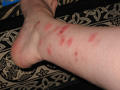
- The reaction to bed bug bites varies, from no reaction to severe skin inflammation, irritation, and itching.
- A small, hard, swollen, white welt may develop at the site of each bite. Severe itching can last for several hours to days in the irritated, inflamed bite area.
- A bedbug generally feeds at night, but if it is hungry and the area has a dim light, it may feed during the day.
- If left undisturbed, a full-grown bedbug becomes engorged with blood in 3 to 5 minutes. It then crawls into hiding, remaining there for several days to digest its meal. When hunger returns, the bug emerges from hiding and seeks another blood meal.
They Feed On Humans
- While bedbugs feed primarily on humans, they also feed on other mammals, poultry, and other birds. Their host range is confused by the fact that the insect family Cimicidae, of which the common bedbug is a member, has several closely related species with similar habits and appearance.
- They are spread mainly by clothing and baggage of travelers and visitors, secondhand beds, bedding materials, furniture, laundry, and even moving company blankets. Nesting birds, rodents, squirrels, and poultry can be carriers and can enter through open windows.
- The mature bedbug is a brown-to mahogany-colored, wingless insect. Its size depends on how recently it has eaten a blood meal. An unfed bed bug is between 1/4 and 3/8 inches long. The upper surface of its body has a papery, crinkly, flimsy appearance. When engorged with blood, its body becomes elongated and swollen, and its color changes from brown to dull red. The color, size, and shape change from an unfed to a full bug are remarkable.
- Bedbug eggs are white and about 1/3-inch long. Under favorable conditions, the female bedbug lays about 200 eggs at the rate of 3 or 4 per day. Eggs have a sticky coating and stick to objects where they are laid. It usually takes the eggs 6 to 17 days to hatch, and the newly emerged nymphs will feed immediately. A bedbug goes through five molts (shedding of its skin) before it reaches maturity. Depending on environmental factors and the availability of food, there can be considerable variation in developmental rate.
- Bedbugs may live for several weeks to several months without feeding, depending on temperature.
Bloods Spots on Sheets and Sickly Sweet Odor
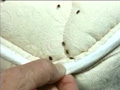
Heavily used hiding places are evident by black or brown spots of dried blood and excrement on the surfaces where the bugs rest, like your bed. Eggs, egg shells, and cast skins may be found near these places. Usually, there is an offensive, sickly sweet odor where bedbugs are numerous.
Most bug problems are not detected until someone has been bitten. A bed bug infestation can be recognized by blood stains from crushed bugs or by blood (sometimes dark) spots of their droppings on sheets and mattresses, bedclothes, and walls. Fecal spots, eggshells, and shed skins may be found in the vicinity of their hiding places. An offensive, sickly sweet, musty odor from their scent glands may be noticeable with severe bed bug infestations.
Disclaimer
All Natural Ginesis products are safe and non-toxic when used as directed. Natural Ginesis is not a substitute for medical advice. The operators of this website and those who provide information for this site do not directly or indirectly practice medicine or dispense medical advice or services through this website. You should not rely on this information to determine a diagnosis or course of treatment, nor should it be considered a replacement for consultation with a physician or other certified healthcare provider. Natural Ginesis and its distributors do not make representations or warranties with respect to any information offered or provided on or through any company websites regarding treatment, action, or application of the product. Neither Natural Ginesis nor any of its divisions or contributors shall have any liability for the content, errors, or omissions in the information provided by this website. Neither Natural Ginesis nor its distributors are responsible or liable for any advice, course of treatment, diagnosis, or any other information, services, or products that you obtain through this site. Those with health problems, pregnancy, or who are nursing are specifically advised that they should consult their physician before taking any nutritional supplement.
Thank You!